What are the most dangerous pollutants coming from industries?
In this article we will delve into some of the most dangerous pollutants in the atmosphere and to what extent the sector industrial contributes to their emission. Contrary to common sense, in the last thirty years considerable progress has been made in reducing emissions in this sector, while for example in the same period there have been increases in other sectors, such as that of residential heating .
Let's see what the most polluting substances present in the atmosphere are.
Sulfur oxides: SOx
When we refer to SOx we mean the sulfur oxides mostly present in the atmosphere which are sulfur dioxide (SO2) and sulfur trioxide (SO3). SO2 is among the most aggressive and dangerous air pollutants. The primary source of production of this compound is the combustion of coal, oil and diesel. The oxidation of SO2 generates SO3, which reacts with water to produce sulfuric acid, which is the main cause of acid rain.
As reported in the report Ispra 2020, Italian Emission Inventory 1990-2018 , Italy has already achieved the SOx reduction objectives set for 2030. The greatest contribution to this reduction was precisely from the industrial sector with decreases from all sectors, from energy production to the chemical industry. We are talking about a decrease of more than 90%. What are the causes? The main factors include the adoption of natural gas instead of coal and other fossil fuels, the decrease in the percentage of sulfur present in fuels, and more stringent laws regulating emissions.

Nitrogen monoxide and dioxide: NOx
Now we come to NOx, term which essentially refers to nitrogen monoxide and nitrogen dioxide (NO and NO2). These oxides have both natural origins, such as in volcanic eruptions, and anthropogenic origins, in those processes where combustion takes place at high temperatures, such as in vehicle engines or in general in industrial combustion plants. NO and NO2 are both toxic to the environment and to health, but the most dangerous is certainly NO2 . This is in fact one of the bases for the production of secondary pollutants such as ozone or nitric acid. It also contributes about a third to the formation of acid rain.
The two sectors that contribute most to NOx emissions are transport and industry, but how have things been from 1990 to today.
The Ispra report speaks of a marked decline, -68%, from 1990 to 2018 , and the two sectors driving the reduction were transport and industrial. In detail we have a reduction of 91% in the energy sector and 77% in industrial processes .
As in the case of SOx, the introduction, starting from 1988, of regulations to regulate emissions from plants, rules which have gradually become more stringent, have given the greatest impetus to the reduction of emissions. This was accompanied by the use of natural gas instead of fossil fuels, the adoption of renewable energy sources and greater energy savings.
Particulate Matter: PM10 and PM2.5
PM10 is an acronym that stands for Particulate Matter ≤ 10 µm (naturally the same applies to PM2.5, only the diameter changes). What is therefore indicated is very small particulate material that is dispersed in the lower atmosphere. The composition of this pollutant is both natural, volcanic eruptions, pollen, fires, etc., and artificial, deriving from the use of fossil fuels, and this is obviously what causes the greatest concern.
The dependence of our economy on this type of energy source is still predominant, however in recent years considerable progress has been made and the data presented in the Ispra report for our country underlines this effort. In this case, the industrial sector we are evaluating in this article has seen a decline in emissions of both forms of particulate matter. Let's see the details together.
In the period 1990-2018 the emission of PM10 had a decrease of approximately 40% . If we look at the data by sector, the sharpest decline occurred precisely in the industrial sector with a -71% in industrial combustion processes, -49% in productive ones and -98% in the energy sector. As regards PM2.5 the percentages are -67% for combustion processes and -97% for production and energy.
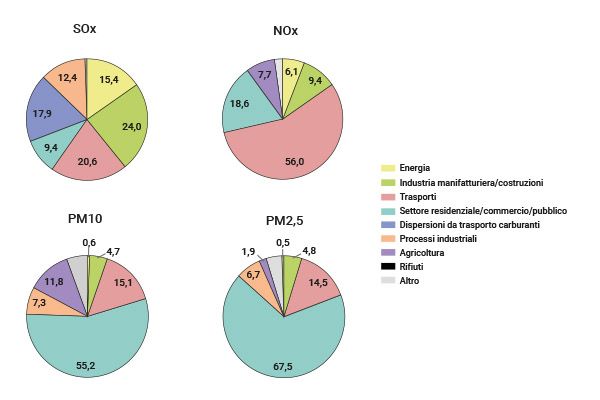
Source: Ispra Report - Informative Inventory Report 2020 - Italian Emission Inventory 1990-2018
These results were achieved thanks to stricter regulations on industrial emissions. This has consequently led residential heating to be the main source of particulate matter, as no control measures have been implemented in this sector.
Air pollution in Italy
What do we deduce from the trend of the data series? The positive note is undoubtedly the general reduction of emissions for the industrial sector , even if in the general picture there is still a lot of work to be done, especially as regards the residential/commercial heating sector.
In industry, the decline in emissions was due to several concomitant factors: the replacement of fuels such as coal, with e.g. methane gas, more stringent regulations and controls to regulate emissions, but a contribution also came from the delocalisation of production and the economic crisis of 2008.
Alongside this, in the specific case of Italy , part of the reduction was due to a decreased productivity of cement factories and some chemical companies.
Overall we can therefore say that we are moving in the right direction, but we need the awareness that on the path to sustainability and emissions reduction we can only accelerate to get there. carbon neutrality which is now the objective being set globally.